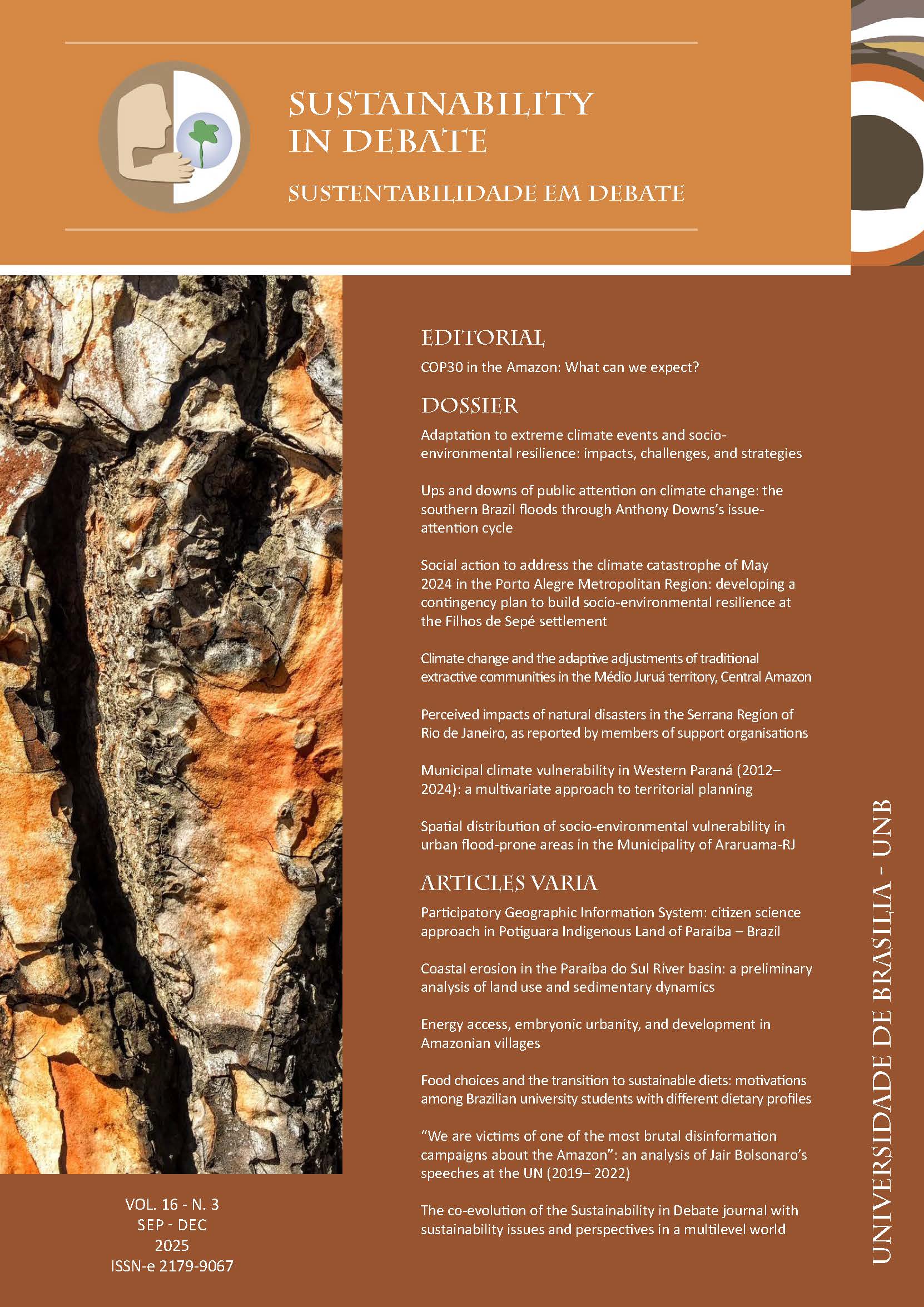
Climate change and the adaptive adjustments of traditional extractive communities in the Médio Juruá territory, Central Amazon
DOI:
https://doi.org/10.18472/SustDeb.v16n2.2025.58115Keywords:
Resilience, Adaptation, Extreme events, Heat increase, River environmental disastersAbstract
In the Médio Juruá territory, local governance is strongly led by extractive communities. However, climate change has made the adaptations of riverine socio-ecological systems insufficient in the face of transformations in the region's physical-climatic rhythms. With this in mind, this study aimed to analyse climate change in terms of temperature and fluvial disasters, its socio-environmental implications and the adaptive adjustments adopted by extractivist communities in Médio Juruá. We combined analysis of physical climate data and semi-structured interviews with social actors from traditional riverside communities in the region. We found that climate change is already impacting the region. Extractive communities are feeling the impacts of increased excessive heat, rainfall, and extreme fluvial events, which are altering the dynamics of work and life in these communities. Communities are responding with a series of autonomous, adaptive adjustments, while government strategies are limited to emergency support. Traditional extractive communities need robust adaptation policies and programs that can increase the resilience of their socio-ecological systems.
Downloads
References
ABREU, R. P.; OLIVEIRA, H. S. A influência das mudanças sazonais nos aspectos naturais e sociais no careiro da várzea – Am. Eixo temático: clima, ambiente e atividades rurais. Revista Geonorte, Edição Especial 2, v. 2, n. 5, p.1399 –1408, 2012.
ARTAXO, P. As três emergências que nossa sociedade enfrenta: saúde, biodiversidade e mudanças climáticas. Estudos avançados, v. 34, p. 53-66, 2020.
BALDIN, N.; MUNHOZ, E. M. B. Snowball (bola de neve): uma técnica metodológica para pesquisa em educação ambiental comunitária. In: CONGRESSO NACIONAL DE EDUCAÇÃO. 2011. p. 329-341.
BEDRAN-MARTINS, A. M. B. Avaliação dos impactos de políticas públicas de transferência de renda na qualidade de vida no semiárido nordestino face às mudanças climáticas. São Paulo, 2016. Tese (Doutorado em Saúde Pública) – Faculdade de Saúde Pública, Universidade de São Paulo. São Paulo, 2016.
BULKELEY, H. Cities and governing of climate change. Annu. Rev. Environ. Resour. v. 35, p. 229-53, 2010.
CHOWDHURY, J. M. A. S.; KHALEK, M. A.; KAMRUZZAMAN, M. Farmers’ climate change perception, impacts and adaptation strategies in response to drought in the Northwest area of Bangladesh. Climate Services, v. 38, p. 100540, 2025.
DOS SANTOS, Y. C. et al. Enfrentamento aos riscos das mudanças climáticas no semiárido brasileiro: a adaptação climática como uma nova agenda governamental. Revista de Gestão dos Países de Língua Portuguesa, v. 22, n. 1, p. 46-66, 2023.
EAKIN, H. et al. Differentiating capacities as a means to sustainable climate change adaptation. Global Environmental Change, v. 27, p. 1-8, 2014.
ENGLE, N. L. Adaptive capacity and its assessment. Global Environmental Change, v. 21, p. 647-56, 2011.
ESPINOZA, J. C.; MARENGO, J. A.; RONCHAIL, J.; MOLINA, J.; NORIEGA, L.; GUYOT, J. L. The extreme 2014 flood in South-Western Amazon basin: the role of tropical-subtropical South Atlantic SST gradient. Environ. Res. Lett. 9: 124007. DOI: 10.1088/1748-9326/9/12/124007. 2014
FEARNSIDE, P. M. A vulnerabilidade da floresta amazônica perante as mudanças climáticas. Oecologia Australis, v. 13, n. 4, p. 609-618. 10.4257/oeco.1304.05. 2009.
FEARNSIDE, P. M. Dams in the Amazon: Belo Monte and Brazil’s hydroelectric development of the Xingu River Basin. Environmental management, v. 38, n. 1, p. 16-27, 2006. Available at: https://doi.org/10.1007/s00267005-0113-6.
FILIZOLA, N. P.; SILVA, A. V. da; SANTOS, A. M. C. dos; OLIVEIRA, M. A. Cheias e secas na Amazônia: breve abordagem de um contraste na maior bacia hidrográfica do globo. In: T&C Amazônia, v. 9, p. 42-49, 2006.
GIL, A. C. Como elaborar projetos de pesquisa. São Paulo: Atlas, 2002.
GOLDEN GATE WEATHER SERVICES. El Niño and La Niña Years and Intensities. 2021. Available at: https://ggweather.com/enso/oni.htm
GUIMARÃES, D. F. da S.; BELMIRO, C. dos S.; VASCONCELOS, M. A. de; PEREIRA, H. dos S. Percepção de risco e avaliação de respostas governamentais por populações ribeirinhas em Cacau Pirêra, Iranduba/AM. Sustainability in Debate, v. 10, n. 3, p. 236–275, 2019. Available at: https://doi.org/10.18472/SustDeb.v10n3.2019.23711.
GUIMARÃES, D. F. S.; VASCONCELOS, M. A.; WEIL, A. G.; SCHOR, T. Os povos da floresta na produção do espaço e da sustentabilidade na Amazônia: o caso do território do Médio Juruá – Carauari/AM. Antíteses, [S. l.], v. 16, n. 31, p. 059–086, 2023. DOI: 10.5433/1984-3356.2023v16n31p059-086. Available at: https://ojs.uel.br/revistas/uel/index.php/antiteses/article/view/47613. Access at: 4 maio 2025.
GUIMARÃES, D. F. S.; VASCONCELOS, M. A.; VIDAL, T. D. C. S.; dos SANTOS, P. H. A relação entre eventos climáticos extremos e desastres ambientais fluviais no Amazonas. Research, Society and Development, v. 10, n. 9, p. e25510917882-e25510917882, 2021. Available at: http://dx.doi.org/10.33448/rsd-v10i9.17882.
IPCC Summary for policymakers. In: Climate Change 2014: impacts, adaptation, and vulnerability. Part A: Global and Sectoral Aspects. Contribution of Working Group II to the Fifth Assessment Report of the Intergovernmental Panel on Climate Change (Cambridge, United Kingdom and New York, NY, USA) ed C B Field et al. (Cambridge University Press) p. 1–32.
IPCC Fourth Assessment, Impacts [2007]. Intergovernmental Panel On Climate Change. Climate Change 2007: impacts, adaptation and vulnerability. Working Group II Contribution to the Intergovernmental Panel on Climate Change, Summary for Policymakers, April. Available at: http://www.ipcc.ch/.
IPCC. Climate Change 2007: the physical science basis, summary for policy makers, February 2007.
LARAIA, R. de B. Cultura – Um Conceito Antropológico. 11.ª edição, Rio de Janeiro: Jorge Zahar Editor, 1996.
LIBERATO, A. M. Estudo de Eventos Climáticos Extremos na Amazônia Ocidental e seus Impactos na Hidrovia Rio Madeira. Tese (Doutorado em Meteorologia) – Universidade Federal de Campina grande. Campina Grande, 2014. Available at: http://dca.ufcg.edu.br/posgrad_met/teses/AiltonMarculinoLiberato_2014.pdf. Access at: 05 jan. 2018.
MARCHEZINI, V. et al. O que são eventos extremos? Uma reflexão sobre as diferentes perspectivas do termo. Revista Brasileira de Climatologia, v. 2, 2023.
MARENGO, J. A.; TOMASELLA, J.; SOARES, W. R.; ALVES, L. M.; NOBRE, C. A. Extreme climatic events in the Amazon basin. Climatological and hydrological context of recent floods. Theor Appl Climatol. v. 107, p. 73–85, 2012.
MARENGO, J. A.; ESPINOZA, J. C. Extreme seasonal droughts and floods in Amazonia: causes, trends and impacts. International Journal of Climatology, v. 36, n. 3, p. 1033-1050. 2016. Available at: https://doi.org/10.1002/joc.4420.
MARENGO, J. A.; SOUZA, JR. C. Mudanças climáticas, impactos e cenários para a Amazônia. São Paulo. p. 1-33, 2018
MARENGO, J. A. et al. Onset and end of the rainy season in the Brazilian Amazon Basin. Journal of Climate, v. 14, n. 5, p. 833-852, 2001. Available at: https://doi.org/10.1175/1520-0442(2001)014<0833:OAEOTR>2.0.CO;2
MAY, P. H.; VINHA, V. Adaptação às mudanças climáticas no Brasil: o papel do investimento privado. Estudos Avançados, v. 26, n. 74, p. 229–246, 2012. Available at: https://doi.org/10.1590/S0103-4014201200010001.
MORAN, E. F. A Ecologia Humana das Populações da Amazônia. São Paulo, Vozes, 1974.
MORAN, E. Adaptabilidade Humana: uma introdução à antropologia ecológica. São Paulo: Editora da Universidade de São Paulo. 1994
MORAN, E. F. Meio ambiente e ciências sociais: interações homem-ambiente e sustentabilidade. São Paulo: editora Senac São Paulo, 2011.
PASSOS, M. S.; CAMPOS-SILVA, J. V. Análise Temporal da dinâmica fluvial do Rio Juruá, AM, Brasil. In: 16º SIMPÓSIO DE GEOLOGIA DA AMAZÔNIA: geociências e geopolítica na Amazônia. 2019.
PASSOS, M. S.; SOARES, E. A. A. Análise multitemporal do sistema fluvial Solimões-Amazonas entre os tributários Purus e Negro, Amazônia Ocidental, Brasil. Geologia USP. Série Científica, v. 17, n. 1, p. 61-74, 2017.
PEREIRA, D. M.; SZLAFSZTEIN, C. F. Ameaças e desastres naturais na Amazônia Sul Ocidental: análise da Bacia do Rio Purus. Raega – O Espaço Geográfico em Análise, v. 35, p. 68-94, 2016.
ROCHA, D.; DEUSDARÁ, B. Análise de Conteúdo e Análise do Discurso: aproximações e afastamentos na (re)construção de uma trajetória. Alea: estudos neolatinos, v. 7, p. 305-322, 2005.
SETTE, D. M. O holorritmo e as interações trópico-extratrópico na gênese do clima e as paisagens do Mato Grosso. 2000. Tese (Doutorado) – Universidade de São Paulo, São Paulo, 2000.
SETTE, D. M.; RIBEIRO, H. Interações entre o clima, o tempo e a saúde humana. InterfacEHS – Revista de Saúde, Meio Ambiente e Sustentabilidade, v. 6, n. 2, 2011.
SOUZA, P. M. B. et al. Influence of Climate Change on Working Conditions in The Late 21st Century1. Ambiente & Sociedade [online]. v. 23, 2020.
TARIFA, J. R. Os climas nos maciços litorâneos da Juréia-Itatins: um ensaio de ritmanálise. 2002. Tese (Livre Docência) – Universidade de São Paulo, São Paulo, 2002.
TEKLAY, A. et al. Climate change perceptions and adaptation responses among smallholder farmers across three locations in Megech Watershed, Ethiopia. Climate Services, v. 38, 2025, p. 100566.
TEIXEIRA, R. L. P. et al. Pensando no hoje e no futuro: iniciativas de mudanças climáticas nas capitais do Nordeste do Brasil. Confins. Revista Franco-Brasileira de Geografia, n. 52, 2021. Available at: https://journals.openedition.org/confins/41749. Access at: 20 set. 2022.
TUCCI, C. E. M. Impactos da variabilidade climática e uso do solo sobre os recursos hídricos. Brasília: Agência Nacional de Águas, 2002. 150 p.
VASCONCELOS, M. A. A natureza mudou: alterações climáticas e transformações nos modos de vida da população no baixo Rio Negro, Amazonas. Tese (Doutorado em Ciências do Ambiente e Sustentabilidade) – Universidade Federal do Amazonas, 2020.
WITKOSKI, A. C. Terras, florestas e águas de Trabalho: os camponeses amazônicos e as formas de uso de seus recursos naturais. 2. ed. São Paulo. 2010.
ZENG, N. et al. Causes and impacts of the 2005 Amazon drought. Environmental Research Letters, v. 3, n. 1, p. 014002, 2008.
Downloads
Published
How to Cite
Issue
Section
License
Copyright (c) 2025 Sustainability in Debate

This work is licensed under a Creative Commons Attribution-NonCommercial-NoDerivatives 4.0 International License.
SUSTAINABILITY IN DEBATE – Copyright Statement
The submission of original scientific work(s) by the authors, as the copyright holders of the text(s) sent to the journal, under the terms of Law 9.610/98, implies in the concession of copyrights of printed and/or digital publication to the Sustainability in Debate Journal of the article(s) approved for publication purposes, in a single issue of the journal. Furthermore, approved scientific work(s) will be released without any charge, or any kind of copyright reimbursement, through the journal’s website, for reading, printing and/or downloading of the text file, from the date of acceptance for publication purposes. Therefore, the authors, when submitting the article (s) to the journal, and gratuitous assignment of copyrights related to the submitted scientific work, are fully aware that they will not be remunerated for the publication of the article(s) in the journal.
The Sustainability in Debate Journal is licensed under Creative Commons License – Non-Commercial-No-Derivation Attribution (Derivative Work Ban) 3.0 Brazil, aiming at dissemination of scientific knowledge, as indicated on the journal's website, which allows the text to be shared, and be recognized in regards to its authorship and original publication in this journal.
Authors are allowed to sign additional contracts separately, for non-exclusive distribution of the works published in the Sustainability in Debate Journal (for example, in a book chapter), provided that it is expressed the texts were originally published in this journal. Authors are allowed and encouraged to publish and distribute their text online, following publication in Sustainability in Debate (e.g. in institutional repositories or their personal pages). The authors expressly agree to the terms of this Copyright Statement, which will be applied following the submission and publishing by this journal.



; width: 15%;" id="percentActBar"> </div> </div> <div style="font-size:11px;"><span id="citescorePerVal">15th percentile</span></div> </div> <div style="font-size:12px;text-align:right;">Powered by <span><img alt="Scopus" style="width:50px;height:15px;" src="https://www.scopus.com/static/images/scopusLogoOrange.svg"></span></div> </div> </div> </a>)