
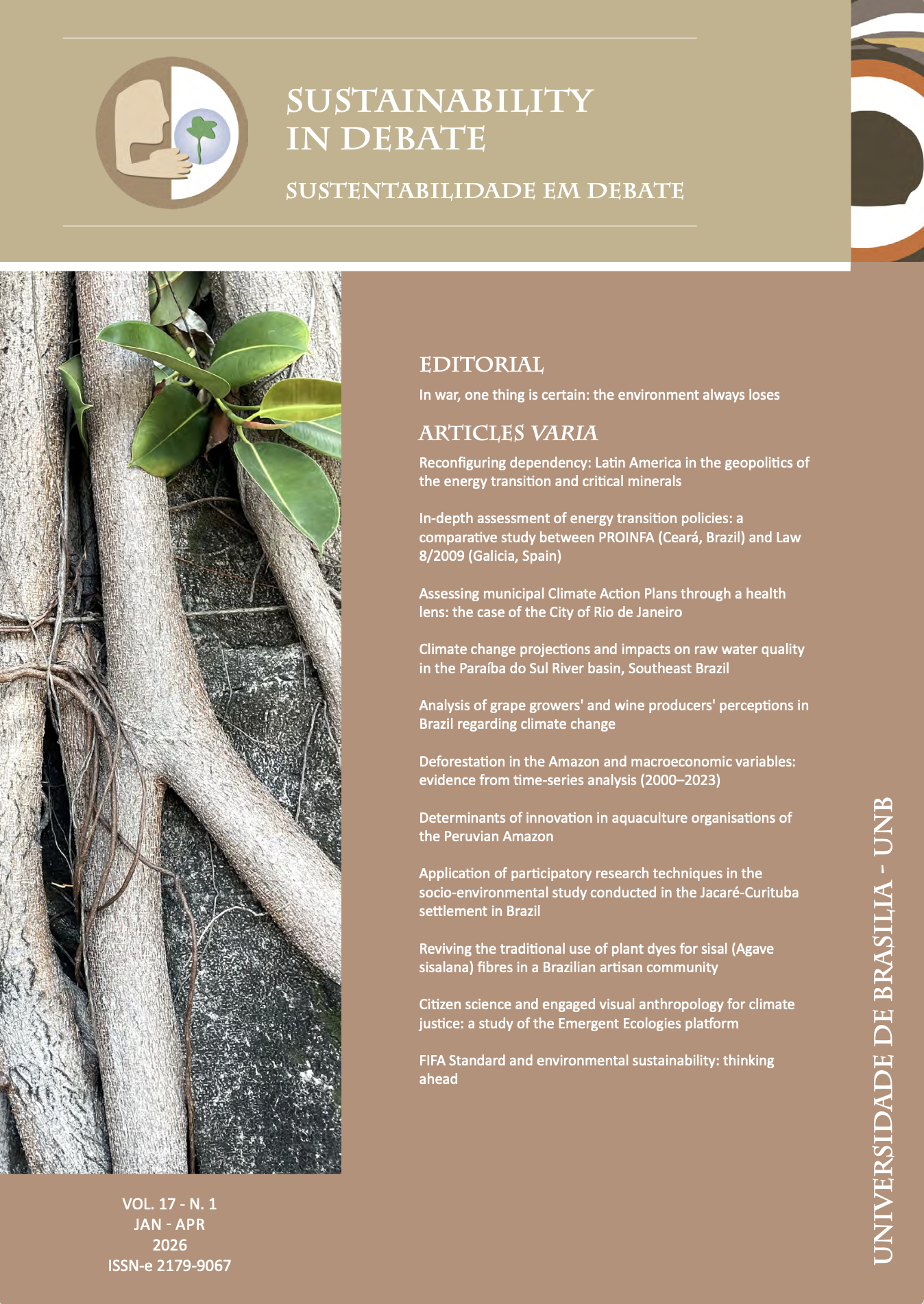
Reviving the use of plant dyes for sisal (Agave sisalana) fibres in a Brazilian artisan community
DOI:
https://doi.org/10.18472/SustDeb.v17n1.2026.58328Keywords:
Dyeing plant, Ethnobotany, Eco-friendly products, Natural dyes, Traditional knowledgeAbstract
Sisal fibre handicrafts, common in tropical regions, traditionally relied on plant-based dyes. However, these have largely been replaced by synthetic dyes, contributing to the loss of traditional knowledge.
This study aimed to document plant species historically used to dye sisal and assess the potential for
reintroducing natural dyes in a Brazilian artisan community. An ethnobotanical study was conducted through interviews and participatory dyeing workshops with 154 artisans selected via the snowball sampling method. Although artisans relied exclusively on synthetic dyes, they recalled 33 plant species that had formerly been used for dyeing. The trials expanded the range of natural dye options for sisal
and renewed artisan nterest in producing market-aligned colours. The adoption of eco-friendly, nontoxic, low-cost natural dyes that add value to their crafts also strengthened community engagement.
Efforts like this, especially in regions rich in plant and cultural diversity, help preserve traditional practices and support more sustainable artisanal production.
Downloads
References
ALBUQUERQUE, U. P.; LUCENA, R. F. P.; LINS NETO, E. M. F. Selection of research participants. In: ALBUQUERQUE, U. P.; CUNHA, L. V. F. C.; LUCENA, R. F. P.; ALVES, R. R. N. (ed.). Methods and techniques in ethnobiology and
ethnoecology. New York: Springer, 2014a. p. 1-13.
ALBUQUERQUE, U. P.; RAMOS, M. A.; LUCENA, R. F. P.; ALENCAR, N. L. Methods and techniques used to collect ethnobiological data. In: ALBUQUERQUE, U. P. et al. (ed.). Methods and techniques in ethnobiology and ethnoecology. New York: Springer, 2014b. p. 15-37.
BALICK, M. A.; COX, P. A. Plants, people, and culture: the science of ethnoboany. New York: Garlan Science, 2020.
BECHTOLD, T. et al. Natural dyes in modern textile dyehouses – how to combine experiences of two centuries to meet the demands of the future? Journal of Cleaner Production, v. 11, p. 499-509, 2003.
BECKER, D. Color trends and selection for product design: every color sells a story. Amsterdam: Elsevier, 2016. 284 p.
BINA, O. The green economy and sustainable development: an uneasy balance? Environment and Planning C - Government and Policy, v. 31, n. 6, p.1023–1047, 2013.
CAPARRÓS, A. R. Colores y colorantes de América. Anales del Museo de América, v. 3, p. 145-160, 1995.
CHAND, N.; ROHATGI, P. K. Natural fibres and their composites. In: CHAND, N.; MOHAMMED, F. (ed.). Tribology of natural fiber polymer composites. New Delhi: Allied Publishers, 1994. p. 1-58.
CHE, J.; YANG, X. A recent (2009–2021) perspective on sustainable color and textile coloration using natural plant resources. Heliyon, v. 8, e10979, 2022.
COSTA, C. et al. Textile industry in a changing world. Journal of Engineering, v. 6, n. 2, p. 86-97, 2020.
COSTA, F. V.; GUIMARÃES, M. F. M.; MESSIAS, M. C. T. B. Gender differences in traditional knowledge of useful plants in a Brazilian community. PLoS One, v. 16, n. 7, e0253820, 2021.
DAN, S. et al. Ammonia application in dye and cleaning. In: BASILE, A.; RAHIMPOUR, M. R. (ed.). Progresses in ammonia: science, technology and membranes. Amsterdam: Elsevier, 2024. p. 95-111.
DAS, H.; KALITA, D. Fibers and dye yielding plants of northeast India. In: PURKAYASTHA, J. (ed.). Bioprospecting of indigenous bioresources of northeast India. Singapore: Springer, 2016. p. 77-99.
DONKIN, R. A. Bixa orellana: the eternal shrub. Anthropos, v. 69, n. 1/2, p. 33-56, 1974.
FERREIRA, E. L. Corantes naturais da flora brasileira: guia prático de tingimento com plantas. Curitiba: Optagraf, 1998. 98 p.
FLORA E FUNGA DO BRASIL. Jardim Botânico do Rio de Janeiro. 2026. Available at: http://floradobrasil.jbrj.gov.br/. Accessed on: 16 Mar 2026.
FORZZA, R. C. et al. New Brazilian floristic list highlights conservation challenges. BioScience, v. 62, p. 39-45, 2012.
GANDURI, L. et al. Potential of natural dye processing in Matabeleland South Province: case study of Masendu Ward, Bulilima-Mangwe District, Zimbabwe. Zimbabwe Journal of Science and Technology, v. 2011, MS11.
GHOSE, A.; ALI, S. M. Protection and preservation of traditional cultural expression and traditional knowledge in handicraft industry: advocating the need for a global cultural policy framework. Brazilian Journal of International
Law, v. 20, n. 2, p. 472-497, 2023.
GONÇALVES, T. Mãos que contam histórias: vida e obra de artesãos cachoeirenses. Ouro Preto: UFOP, 2023. 122 p.
GOOROOCHURN, J.; SOOCHETA, A. V. Extraction of natural dyes from locally available sources and their application on the extracted sisal fibres. In: Knowledge to Action, 9th ed. Mauritius: University of Mauritius, 2016. p. 125-126.
IBGE. INSTITUTO BRASILEIRO DE GEOGRAFIA E ESTATÍSTICA. Censo 2010. Available at: https://censo2010.ibge.gov.br/. Accessed on: 24 July 2012.
KALA, C. P. Uses and management of ethnobotanical species in deciduous forests of Chhattisgarh state in India. Journal of Ethnobiology and Ethnomedicine, v. 5, p. 20, 2009.
KANT, R. Textile dyeing industry an environmental hazard. Natural Science, v. 4, n. 1, p. 22-26, 2012.
KUMAR, P. S. S.; ALLAMRAJU, K. V. A review of natural fiber composites [jute, sisal, kenaf]. Materials Today: proceedings, v. 18, n. 7, p. 2556-2562, 2019.
LIU, Y. et al. Ethnobotany of dye plants in Dong communities of China. Journal of Ethnobiology and Ethnomedicine, v. 1, p. 23, 2014
MACFOY, C. Ethnobotany and sustainable utilization of natural dye plants in Sierra Leone. Economic Botany, v. 58, p. S66–S76, 2004.
MAHANTA, D.; TIWARI, S. C. Natural dye-yielding plants and indigenous knowledge on dye preparation in Arunachal Pradesh, northeast India. Current Science, v. 88, n. 9, p. 1474–1480, 2005.
MARISELVAM, R. et al. Blossoming beauty: enhancing natural fibres with Calendula officinalis L. flower dye and assessing color fastness with microbial properties. Fibres & Textiles in Eastern Europe, v. 31, n. 4, p. 30-37, 2023.
MAYOLO, K. K. A. Peruvian natural dye plants. Economic Botany, v. 43, p. 181-191, 1989.
MESSIAS, M. C. T. B. et al. Popular use of medicinal plants and the socioeconomic profile of the users: a study in the urban area of Ouro Preto, Minas Gerais, Brazil. Revista Brasileira de Plantas Medicinais, v. 17, p. 76-104, 2015.
NAYAK, L. et al. Utilisation of sisal fibre (Agave sisalana L.) – a review. Agricultural Reviews, v. 32, n. 2, p. 150-152, 2011.
PARMA, M. G.; BERALDO, H.; MENDES, I. C. Study of a Brazilian manuscript from the 18th century: physicochemical identification of inks compositions and elucidation of painting techniques. Journal of Cultural Heritage, v. 59, p.
113-119, 2023.
PRABHU, K. H.; BHUTE, A. S. Plant based natural dyes and mordants: a review. Journal of Natural Product and Plant Resources, v. 2, n. 6, p. 649-664, 2012.
PRADO, A. C. C. et al. Etnobotânica como subsídio à gestão socioambiental de uma unidade de conservação de uso sustentável. Rodriguésia, v. 70, e02032017, 2019.
RAMADHANTI, R. A. et al. Leveraging ethnobotany to unlock the green economy potential of Flores through local textile industry. Earth and Environmental Science, v. 391, p. 012047, 2019.
SÁ, I. M.; ALMEIDA, G. S.; SENNA-VALLE, L. A tradição do uso de plantas tintoriais da comunidade rural de Santo Antônio do Rio Grande. Revista Brasileira de Biociências, v. 5, supl. 1, p. 276-278, 2007.
SABUNA, A. C.; NOMLENI, F. T. Identification of plants natural dye by Meto tribe in South Central Timor. Materials Science and Engineering, v. 823, p. 012037, 2020.
SABUNA, A. C.; DAUD, Y.; NGGINAK, J. Ethnobotany study of natural dyes by women in Hundihopo Village, East Rote District, Rote Ndao Regency. In:
SABUNA, A. (ed.). Climate change, biodiversity, food security and local
knowledge. Kupang: Artha Christian University, 2018. p. 238-448.
SERAN, W. et al. Identification and distribution of plants that have the potential as natural dyes for ikat weaving in Malacca District. Agrikan Journal Agribisnis Perikanan, v. 15, n. 2, p. 621-628, 2022.
SIMPSON, B. B.; OGORZALY, M. C. Economic botany: plants in our world. New York: McGraw Hill, 2001. 544 p.
TOLEDO, V. M.; BARRERA-BASSOLS, N. A memória biocultural: a importância das sabedorias tradicionais. São Paulo: Expressão Popular, 2015. 272 p.
URRIAGO-OSPINA, L. M. et al. Traditional ecological knowledge in a ferruginous ecosystem management: lessons for diversifying land use. Environment, Development and Sustainability, v. 23, p. 2092-2121, 2021.
WORLD FLORA ONLINE. Available at: http://www.worldfloraonline.org. Accessed on: 22 May 2024.
Downloads
Published
How to Cite
Issue
Section
License
Copyright (c) 2026 Sustainability in Debate

This work is licensed under a Creative Commons Attribution-NonCommercial-NoDerivatives 4.0 International License.
SUSTAINABILITY IN DEBATE – Copyright Statement
The submission of original scientific work(s) by the authors, as the copyright holders of the text(s) sent to the journal, under the terms of Law 9.610/98, implies in the concession of copyrights of printed and/or digital publication to the Sustainability in Debate Journal of the article(s) approved for publication purposes, in a single issue of the journal. Furthermore, approved scientific work(s) will be released without any charge, or any kind of copyright reimbursement, through the journal’s website, for reading, printing and/or downloading of the text file, from the date of acceptance for publication purposes. Therefore, the authors, when submitting the article (s) to the journal, and gratuitous assignment of copyrights related to the submitted scientific work, are fully aware that they will not be remunerated for the publication of the article(s) in the journal.
The Sustainability in Debate Journal is licensed under Creative Commons License – Non-Commercial-No-Derivation Attribution (Derivative Work Ban) 3.0 Brazil, aiming at dissemination of scientific knowledge, as indicated on the journal's website, which allows the text to be shared, and be recognized in regards to its authorship and original publication in this journal.
Authors are allowed to sign additional contracts separately, for non-exclusive distribution of the works published in the Sustainability in Debate Journal (for example, in a book chapter), provided that it is expressed the texts were originally published in this journal. Authors are allowed and encouraged to publish and distribute their text online, following publication in Sustainability in Debate (e.g. in institutional repositories or their personal pages). The authors expressly agree to the terms of this Copyright Statement, which will be applied following the submission and publishing by this journal.





; width: 15%;" id="percentActBar"> </div> </div> <div style="font-size:11px;"><span id="citescorePerVal">15th percentile</span></div> </div> <div style="font-size:12px;text-align:right;">Powered by <span><img alt="Scopus" style="width:50px;height:15px;" src="https://www.scopus.com/static/images/scopusLogoOrange.svg"></span></div> </div> </div> </a>)