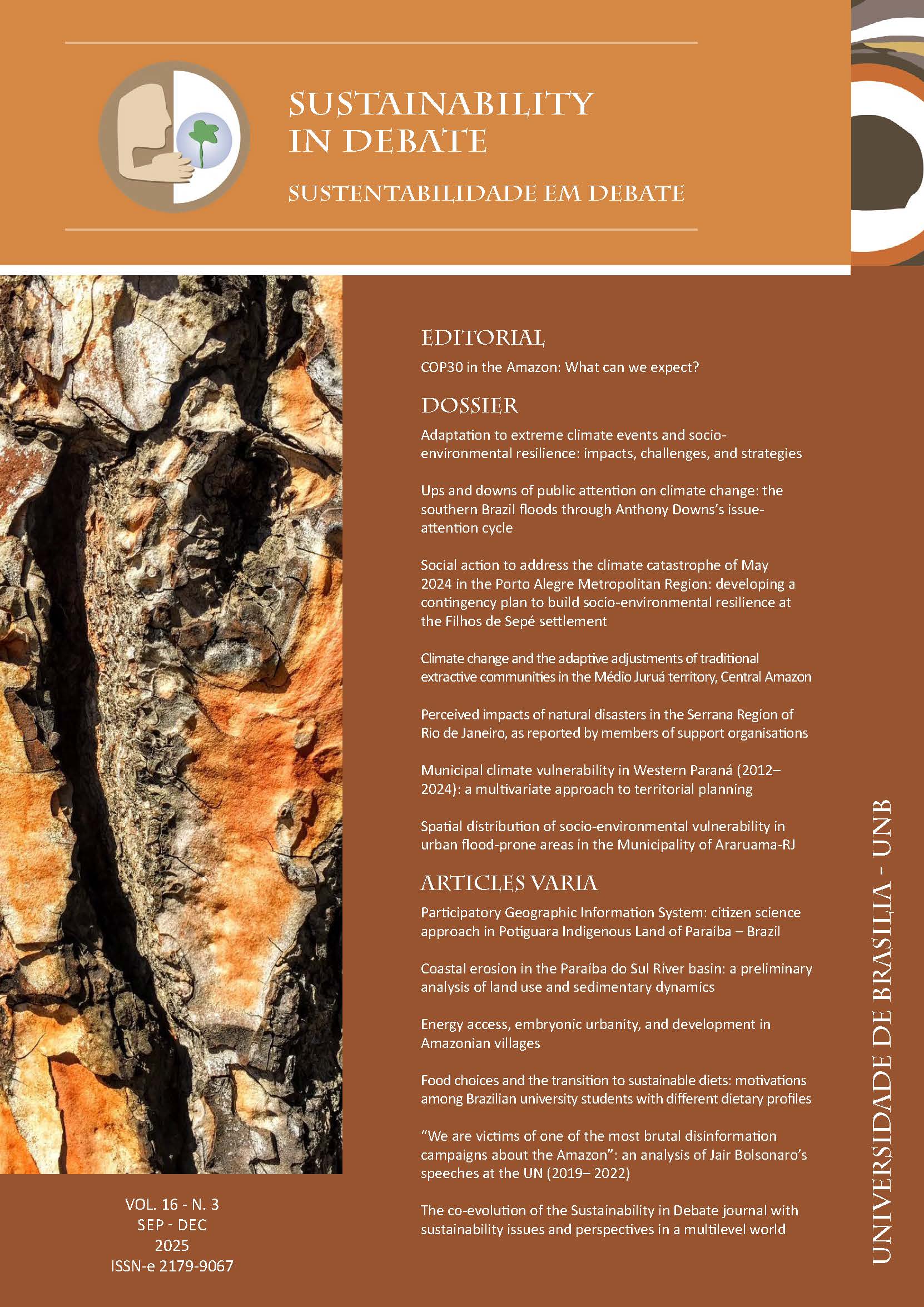
Spatial distribution of socio-environmental vulnerability in urban flood-prone areas in the Municipality of Araruama-RJ
DOI:
https://doi.org/10.18472/SustDeb.v16n3.2025.58067Keywords:
Vulnerability, Flood, Socio-environmentalAbstract
This study analyses socio-environmental vulnerability in Araruama, a municipality in the Lagos São João Hydrographic Region, in Rio de Janeiro, with a history of hydrometeorological disasters and a high number of homeless people. Based on 2010 Census data integrated with the flood susceptibility zone of the SGB and official and media flood records, thematic maps were developed in a GIS environment and crossed with official and media flood records between 2009 and 2023. Twenty-four affected neighbourhoods were identified. The spatialisation of exposure, combined with social vulnerability, enables the identification of the location of the most affected population. Proximity to water bodies was common among the most critical sectors. Areas of extreme socio-environmental vulnerability are located near a river and exhibit low response capacity. The study highlights the need to adopt monitoring
and forecasting systems and public policies for the adaptation of the most affected neighbourhoods
Downloads
References
ALVES, H. P. F. Socio-environmental vulnerability in the São Paulo Macro-metropolis’ three main metropolitan regions: a socio-environmental indicators analysis. Ambiente & Sociedade, v. 24, p. e00302, 2021. Available in: https://doi.org/10.1590/1809-4422asoc20200030r2vu2021L1AO.
ARARUAMA. Plano Municipal de Conservação e Recuperação da Mata Atlântica de Araruama. Araruama: Prefeitura Municipal de Araruama, 2017. Available in: https://www.aemerj.org.br/images/pdf/PMMA/ PMMAAraruama.pdf
BARENDRECHT, M. H.; VIGLIONE, A.; BLÖSCHL, G. A dynamic framework for flood risk. Water Security, v. 1, p. 3–11. 2017. Available in: https://doi.org/10.1016/j.wasec.2017.02.001.
BRASIL. Ministério da Ciência, Tecnologia e Inovação (MCTI). Em 2023, Cemaden registrou maior número de ocorrências de desastres no Brasil. Brasília: MCTI, 19 jan. 2024. Available in: https://www.gov.br/mcti/pt-br/ acompanhe-o-mcti/noticias/2024/01/em-2023-cemaden-registrou-maior-numero-de-ocorrencias-de-desastres no-brasil.
BRASIL. Ministério da Integração e do Desenvolvimento Regional. Sistema Integrado de Informações sobre Desastres – S2ID. Brasília, 2024. Available in: https://s2id.mi.gov.br/paginas/series/
BRASIL. Ministério da Ciência, Tecnologia e Inovações – MCTI, 2024.
CARDOSO, M. M. Estudio de la vulnerabilidad socio-ambiental a través de um índice sintético. Caso de distritos bajo riesgo de inundación: Santa Fe, Recreo y Monte Vera, Provincia de Santa Fe, Argentina. Caderno de Geografia, v. 27, n. 48, p. 156-183, 2017. Available in: https://doi.org/10.5752/P.2318-2962.2017v27n48p156.
CARTIER, R. et al. Vulnerabilidade social e risco ambiental: uma abordagem metodológica para avaliação de injustiça ambiental. Cadernos de Saúde Pública, v. 25, p. 2695-2704, 2009. Available in: https://doi.org/10.1590/ S0102-311X2009001200016.
CHAND, K. et al. Integrating geoenvironmental and socioenvironmental analyses for flood vulnerability assessment in the Kullu Valley, Himachal Pradesh, India. International Journal of Disaster Risk Reduction, v. 108, p. 104494, 2024. Available in: https://doi.org/10.1016/j.ijdrr.2024.104494.
CHAVES, S. V. V. et al. Vulnerabilidade Social da Cidade de Teresina, Piauí. Revista de Geociências do Nordeste, v. 8, n. 2, p. 13-27, 2022. Available in: https://doi.org/10.21680/2447-3359.2022v8n2ID27200.
COPPETEC. Coordenação de Projetos, Pesquisas e Estudos Tecnológicos. Elaboração do plano Estadual de recursos hídricos do Estado do Rio de Janeiro: ocorrências de desastres naturais entre 2000 e 2012 por Região Hidrográfica, 2014. Available in: https://www.agevap.org.br/downloads/Diagnostico-Vulnerabilidades VolII.pdf.
FARIAS, A.; MENDONÇA, F. Riscos socioambientais de inundação urbana sob a perspectiva do Sistema Ambiental Urbano. Sociedade & natureza, v. 34, p. e63717, 2022. Available in: https://doi.org/10.14393/SN-v34-2022 63717.
FOX, S. Integrating social vulnerability into high-resolution global flood risk mapping. Nature communications, v. 15, n. 1, p. 3155, 2024. Available in: https://doi.org/10.1038/s41467-025-56676-2.
FREITAS, C. M. de et al. Desastres naturais e seus custos nos estabelecimentos de saúde no Brasil no período de 2000 a 2015. Cadernos de Saúde Pública, v. 36, 2020. Available in: https://doi.org/10.1590/0102-311X00133419.
G1. Araruama, RJ, tem mais de 700 pessoas desalojadas após chuvas. Available in: https://g1.globo.com/rj/ regiao-dos-lagos/noticia/2016/03/araruama-rj-tem-mais-de-700- pessoas-desalojadas-apos-chuvas.html/ .
GAEDKE, P.; LOHMANN, M.; GALVÃO, R. P. Análise de componentes principais aplicada à identificação da vulnerabilidade socioambiental na área urbana de Londrina/PR. GEOSABERES: Revista de Estudos Geoeducacionais, v. 11, n. 1, p. 693-710, 2020. Available in: https://doi.org/10.26895/geosaberes.v11i0.963.
GOERL, R. Proposta metodológica para mapeamento de áreas de risco à inundação: estudo de caso do município de Rio Negrinho–SC. Boletim de Geografia, 2012. Available in: https://doi.org/10.4025/bolgeogr.v30i1.13519.
GUPTA, A. K. et al. Mapping socio-environmental vulnerability to climate change in different altitude zones in the Indian Himalayas. Ecological Indicators, 2020. Available in: https://doi.org/10.1016/j.ecolind.2019.105787.
IBGE – INSTITUTO BRASILEIRO DE GEOGRAFIA E ESTATÍSTICA. Censo demográfico 2010. Available in: https:// censo2010.ibge.gov.br.
INOUYE, C. E. N.; DE SOUSA, W. C.; DE FREITAS, D. M.; SIMÕES, E. Modelling the spatial dynamics of urban growth and land use changes in the north coast of São Paulo, Brazil. Ocean and Coastal Management, 2015. Available in: https://doi.org/10.1016/J.OCECOAMAN.2014.12.016.
IPCC – Painel Intergovernamental de Mudanças Climáticas. Fourth Assessment Report, 2007.
IPCC – Painel Intergovernamental de Mudanças Climáticas. Fifth Assessment Report, 2014.
IPCC – Painel Intergovernamental de Mudanças Climáticas. Sixth Assessment Report, 2022.
IPEA. Atlas da vulnerabilidade social nos municípios brasileiros. 2015. Available in: https://repositorio.ipea.gov. br/bitstream/11058/4381/1/Atlas_da_vulnerabilidade_social_nos_ municipios_brasileiros.pdf.
IPEA. Atlas da vulnerabilidade social, 2024. Available in: https://ivs.ipea.gov.br/#/.
KRELLENBERG, K. et al. Supporting local adaptation: the contribution of socio- environmental fragmentation to urban vulnerability. Applied Geography, v. 55, p. 61-70, 2014. Available in: https://doi.org/10.1016/j. apgeog.2014.08.013
LINS-DE-BARROS, F. M.; MUEHE, D. Avaliação local da vulnerabilidade e riscos de inundação na zona costeira da Região dos Lagos, Rio de Janeiro. Quaternary and Environmental Geosciences, 2010. Available in: https://doi. org/10.5380/abequa.v2i1-2.14106
MATTEDI, M. A. et al. Aplicação do índice de vulnerabilidade socioambiental a desastres por meio de Sistema de Informação Geográfica (SIG): estudo de caso do Município de Blumenau (SC). Revista de Gestão Ambiental e Sustentabilidade, v. 13, n. 1, p. e23423- e23423, 2024. Available in: https://doi.org/10.5585/2024.23423
O SÃO GONÇALO. Parque Mataruna ganha academia da saúde em praça revitalizada. 2016. Available in: https:// www.osaogoncalo.com.br/regiao-dos-lagos/17268/parque-mataruna- ganha-academia-da-saude-em-praca revitalizada/. Accessed on: 2024.
PEDRAZZI, A. de C.; LANA, J. C. Carta de suscetibilidade a movimentos gravitacionais de massa e inundação: município de Araruama, RJ. Brasília: CPRM [atual SGB – Serviço Geológico do Brasil], set. 2018. Available in: https://rigeo.sgb.gov.br/handle/doc/20190.
RAJU, E.; BOYD, E.; OTTO, F. Stop blaming the climate for disasters. In Communications Earth and Environment, v. 3, Issue 1. 2022. Nature Publishing Group. Available in: https://doi.org/10.1038/s43247-021-00332-2
RENNÓ, C. D. et al. HAND, a new terrain descriptor using SRTM-DEM: mapping terra-firme rainforest environments in Amazonia. Remote Sensing of Environment, v. 112, n. 9, p. 3469-3481, 2008. Available in: https://doi. org/10.1016/j.rse.2008.03.018.
RIBEIRO GOMES, V.; PERES, B.; GUIMARÃES, L. The use of blue-green infrastructure as a multifunctional approach to watersheds with socio-environmental vulnerability. 2021. Available in: https://doi.org/10.2166/ bgs.2021.119.
SAITO, S. M. et al. Disaster risk areas in Brazil: outcomes from an intra-urban scale analysis. International Journal of Disaster Resilience in the Built Environment, v. 12, n. 2, p. 238-250, 2021. Available in: https://doi.org/10.1108/ IJDRBE-01-2020-0008
SERENCO. Elaboração de estudos e projetos para consecução do plano municipal de saneamento básico de Araruama - RJ. 2014. Available in: https://pmsblsj.wordpress.com/wp-content/uploads/2013/10/9-c2ba produto_pmsb_araruama_1013_r0.pdf
SGB. Serviço Geológico do Brasil. Portal Institucional do SGB. 2018. Available in: https://rigeo.sgb.gov.br/handle/ doc/20190.
SILVA, J. F.; DE BRITO NUNES, H. K.; DE AQUINO, C. M. S. Análise integrada do ambiente como subsídio para identificação de riscos e vulnerabilidades socioambientais em Picos/PI. Revista Brasileira de Geografia Física, v. 12, n. 07, p. 2522-2536, 2019. Available in: https://doi.org/10.26848/rbgf.v12.7.p2522-2536.
SIQUEIRA MALTA, F. Vulnerabilidade socioambiental: proposta metodológica e diagnóstico para o município do Rio de Janeiro. 2017. Available in: https://doi.org/10.1590/1413-812320172212.25032017
SZEWRANSKI S. et al. Pluvial flood risk assessment tool (PFRA) for rainwater management and adaptation to climate change in newly urbanised areas. Water 2018. Available in: https://doi.org/10.3390/w10040386.
UNDRR – United Nations Office for Disaster Risk Reduction. Global Assessment Report on Disaster Risk Reduction 2022: Our World at Risk: transforming governance for a resilient future. Geneva: UNDRR, 2022. Available in: https://www.undrr.org/gar2022
ZANETTI, V. B.; JUNIOR, W. C.; FREITAS, D. M. A climate change vulnerability index and case study in a Brazilian coastal city. Sustainability, v. 8, n. 8, p. 811, 2016. Available in: https://doi.org/10.3390/su8080811.
Downloads
Published
How to Cite
Issue
Section
License
Copyright (c) 2025 Sustainability in Debate

This work is licensed under a Creative Commons Attribution-NonCommercial-NoDerivatives 4.0 International License.
SUSTAINABILITY IN DEBATE – Copyright Statement
The submission of original scientific work(s) by the authors, as the copyright holders of the text(s) sent to the journal, under the terms of Law 9.610/98, implies in the concession of copyrights of printed and/or digital publication to the Sustainability in Debate Journal of the article(s) approved for publication purposes, in a single issue of the journal. Furthermore, approved scientific work(s) will be released without any charge, or any kind of copyright reimbursement, through the journal’s website, for reading, printing and/or downloading of the text file, from the date of acceptance for publication purposes. Therefore, the authors, when submitting the article (s) to the journal, and gratuitous assignment of copyrights related to the submitted scientific work, are fully aware that they will not be remunerated for the publication of the article(s) in the journal.
The Sustainability in Debate Journal is licensed under Creative Commons License – Non-Commercial-No-Derivation Attribution (Derivative Work Ban) 3.0 Brazil, aiming at dissemination of scientific knowledge, as indicated on the journal's website, which allows the text to be shared, and be recognized in regards to its authorship and original publication in this journal.
Authors are allowed to sign additional contracts separately, for non-exclusive distribution of the works published in the Sustainability in Debate Journal (for example, in a book chapter), provided that it is expressed the texts were originally published in this journal. Authors are allowed and encouraged to publish and distribute their text online, following publication in Sustainability in Debate (e.g. in institutional repositories or their personal pages). The authors expressly agree to the terms of this Copyright Statement, which will be applied following the submission and publishing by this journal.




; width: 15%;" id="percentActBar"> </div> </div> <div style="font-size:11px;"><span id="citescorePerVal">15th percentile</span></div> </div> <div style="font-size:12px;text-align:right;">Powered by <span><img alt="Scopus" style="width:50px;height:15px;" src="https://www.scopus.com/static/images/scopusLogoOrange.svg"></span></div> </div> </div> </a>)