Judiciary and Administrative State
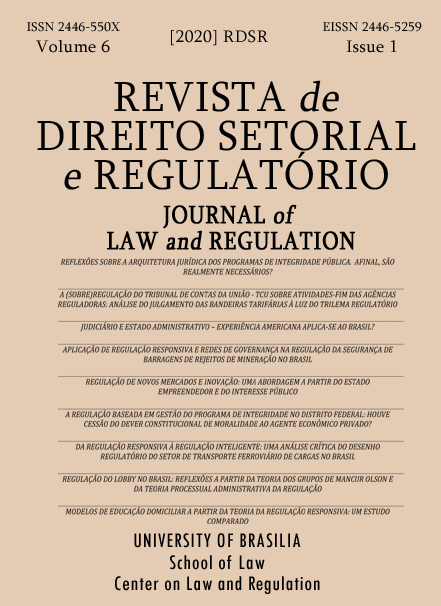
Is the American experience applicable to Brazil?
DOI:
https://doi.org/10.26512/2446-52592020e28448Keywords:
Administrative State, Judiciary, Law’s abnegation, Regulatory State, judicial deference.Abstract
Abstract
Purpose – The Unites States of America has presented for decades an Administrative State culture, in which agencies display normative e judicial functions beyond regular
executive tasks. In this scenery, the American Judiciary grants positions of judicial deference (not without questionings) towards normative acts of these agencies, as seen in the paradigmatic Chevron case, decided by the Supreme Court. For Adrian Vermeule, a true Law’s abnegation exists as a natural process alongside the evolving complexity of modern society and its reflexes on Administrative State. The purpose of this article is to evaluate the American experience in judicial deference and its applicability in the Brazilian Law system.
Methodology/approach/design – The article is based on the studies of the American Administrative State being aligned to the Brazilian Regulatory State, in a Judiciary point of view, exposing a necessary Law’s abnegation in detriment of the Law’s Empire, under the optic of judicial deference, in certain cases.
Findings – In the end, it demonstrates the necessary abstention, regarding certain subjects and circumstances, of the Judiciary towards the regulatory agencies.
Practical implications – The article’s purpose is the enhancement of the judicial practice, aligned with the new ages of a Regulatory State.
Downloads
References
BARBOSA, A. C. Estado Administrativo, Poder Legislativo e a Releitura do Princípio da Separação de Poderes. Journal of Law and Regulation, v. 1, n. 1, p. 163-186, 18 maio 2015.
BENTEMULLER, R. P. P. Poder Judiciário e deferência administrativa: o caso Fator GSF. Journal of Law and Regulation, v. 4, n. 1, p. 21-38, 15 maio 2018.
BINENBOJM, G. Agências Reguladoras Independentes e Democracia no Brasil. Revista de Direito Administrativo, v. 240, p. 147-167, 2005.
ERNST, D. R. Tocqueville’s Nightmare: The Administrative State emergence in America. Oxford University Press: Oxford, 2014.
GOMES, M. C. O lugar da política na atuação das agências reguladoras independentes brasileiras: reflexões sobre a separação dos poderes no Estado moderno. Revista de Direito Setorial e Regulatório, Brasília, v. 3, n. 1, p. 133-164, maio de 2017.
LOPES, O. de A. Fundamentos da Regulação. Rio de Janeiro: Processo, 2018.
MEDEIROS. G. J. M. de. O Estado Regulador e o Estado Administrativo: A Expertise Política e o Governo dos Técnicos. Journal of Law and Regulation, v. 2, n. 2, p. 381-393, 17 out. 2016.
ROSSET, C. A Antinatureza: elementos para uma filosofia trágica. Trad.: Getulio Puell. Rio de Janeiro: Espaço e Tempo, 1989.
SCALIA, A. Judicial Deference to Administrative Interpretations of Law. Duke Law Journal, v. 1989, n. 3, 1989.
SUNSTEIN, Cass R.; VERMEULE, Adrian. The New Coke: On the Plural Aims of Administrative Law. (SSRN-id2631873.pdf). Disponível em https://papers.ssrn.com/sol3/papers.cfm?abstract_id=2631873
VENTURA RODRIGUÉZ. M. E.. Deferencia y discrecionalidad, control judicial y el debilitamiento del Poder Ejecutivo en el Derecho administrativo. 2005. 295 f. Tese (Doutorado) ”“ Universidad Carlos III, Madrid. 2005.
VERMEULE, A. Law’s Abnegation: from Law’s Empire to the Administrative State. Cambridge Massachusets: Harvard University Press, 2016.
WALDO, D. The Administrative State: a study of the political theory of American public Administration. New Brunswick, New Jersey: Transaction Publishers, 2007.
Downloads
Published
How to Cite
Issue
Section
License
Copyright (c) 2020 Journal of Law and Regulation

This work is licensed under a Creative Commons Attribution 4.0 International License.
By submitting this paper to the Journal of Law and Regulation, I hereby declare that I agree to the terms of the Creative Commons Attribution 4.0 International (CC BY 4.0), available at http://creativecommons.org/licenses/by/4.0.