
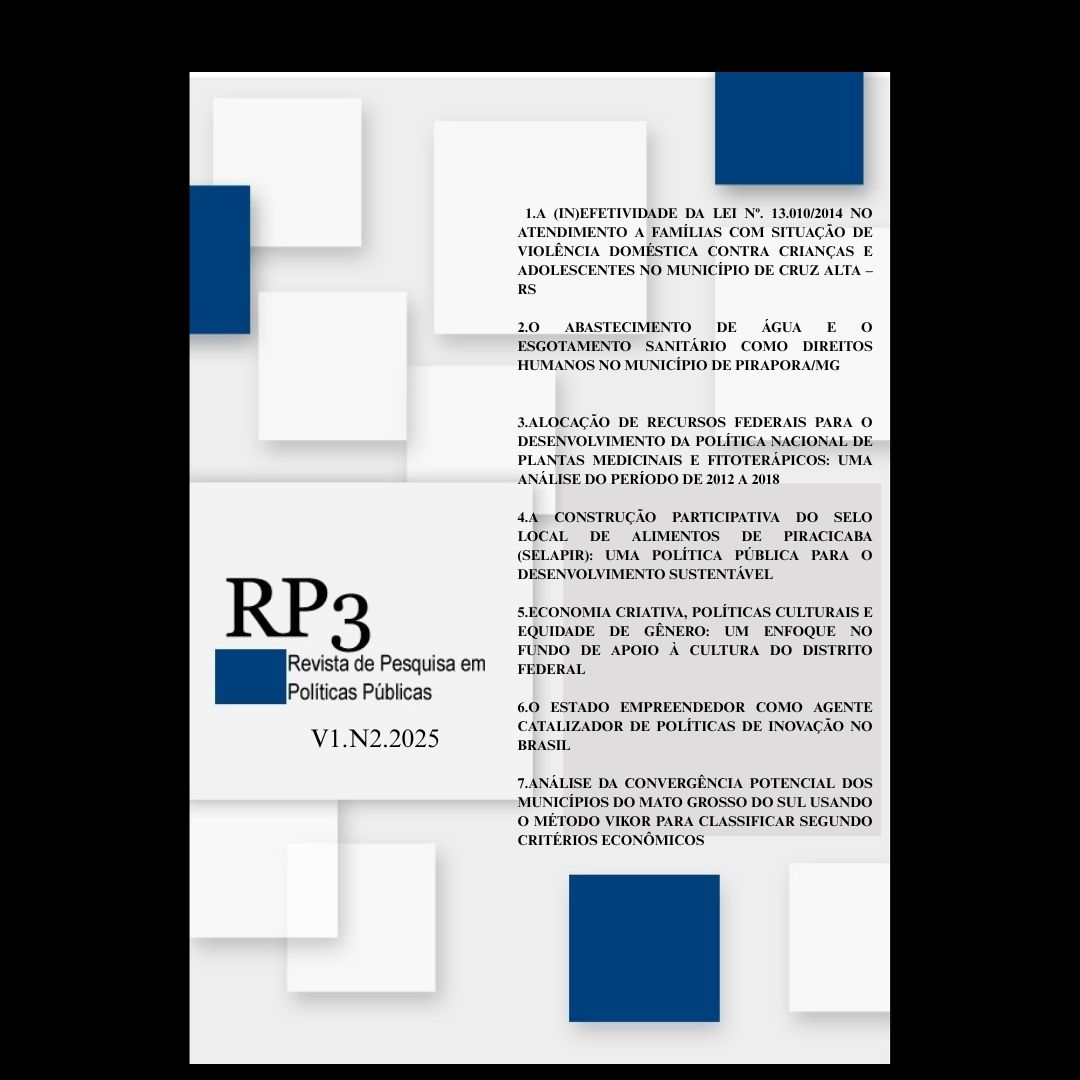
Analysis of the potential convergence of municipalities in Mato Grosso do Sul using the VIKOR method to classify according to economic criteria
DOI:
https://doi.org/10.18829/2317-921X.2025.e59012Keywords:
Multicritério; Vikor; Desenvolvimento Local; Desenvolvimento Regional, convergência econômicaAbstract
This article analyzes possible evidence of convergence and divergence among the 79 municipalities of the state of Mato Grosso do Sul, based on a ten-year period: 2011 and 2021. The methodology used to identify the convergence phenomenon was the VIKOR multicriteria analysis method. The results indicate signs of improvement in most municipalities, although the best-ranked municipalities remain in Campo Grande, Dourados, and Sete Lagoas, with two-thirds showing convergence. Within this universe, two municipalities stood out: Sete Quedas and Maracaju, demonstrating efficiency in both fiscal adjustment and agribusiness. On the other hand, Campo Grande and Três Lagoas, which top this ranking, experienced divergence.
Downloads
References
ACEMOGLU, Daron e ROBINSON, James A. Por que as nações fracassam: as origens do poder, da prosperidade e da pobreza/Daron Acemoglu e James A. Robinson; tradução Cristiana Serra. 2022
BAUMOL, William J.; NELSON, Richard R.; WOLFF, Edward N. Introduction: the convergence of productivity, its significance, and its varied connotations. Convergence of productivity, p. 3-19, 1994.
BRIDA, Juan Gabriel; CARRERA, Edgar J. Sanchez; SEGARRA, Verónica. Clustering and regime dynamics for economic growth and income inequality. Structural Change and Economic Dynamics, v. 52, p. 99-108, 2020.
DÍEZ‐MINGUELA, Alfonso et al. The long‐term relationship between economic development and regional inequality: South‐West Europe, 1860–2010. Papers in Regional Science, v. 99, n. 3, p. 479-508, 2020.
MATO GROSSO DO SUL. Próspero: PIB de Mato Grosso do Sul deve crescer 6,8% e superar R$ 227 bilhões em 2025. 2025. Disponível em https://www.ms.gov.br/noticias/prospero-pib-de-mato-grosso-do-sul-deve-crescer-68-e-superar-r-227-bilhoes-em-2025. Acessado em 12 de julho de 2025
MINARČÍKOVÁ, Eva. Evaluation of regional disparities in Visegrad Four based on selected MCDM methods. In: Proceedings of Online Conference: 9th International Days of Statistics and Economics. 2015. p. 1128-1137.
OPRICOVIC, S. Fuzzy VIKOR with an application to water resources planning. Expert Systems with Apliccations, v. 38, n. 10, p. 12983- 12990, 2011.
OPRICOVIC, S. TZENG, G.. Compromisse solution by MCDM methods: a comparative analysis of VIKOR and TOPSIS. European Journal of Operational Research, v. 16, p. 445-455, 2004.
OPRICOVIC, S. TZENG, G.. Multicriteria planning of post-earthquake sustainable reconstruction. Computer-Aided Civil and Infrastructure Engineering, v. 17, p. 211-220, 2002.
OPRICOVIC, S. TZENG, G.-H. (2007). Extended VIKOR method in comparison with outranking methods. European Journal of Operational Research, 178(2): 514-529.
PETROVIĆ, Jelena; RADUKIĆ, Snežana; RADOVIĆ, Milica. A multicriteria analysis on regional disparity of economic and demographic development in the republic of Serbia. Economic Themes, v. 58, n. 3, p. 327-342, 2020.
POLEDNÍKOVÁ, Eva. Multicriteria evaluation of regional disparities in Visegrad Four. In: The 8th International Days of Statistics and Economics Conference Proceedings September 11–13, 2014, Prague, Czech Republic. 2014. p. 1197-1207.
ROBINSON, James A.; ACEMOGLU, Daron. Why nations fail: The origins of power, prosperity and poverty. London: Profile, 2012.
SHANKAR, Raja; SHAH, Anwar. Bridging the economic divide within countries: A scorecard on the performance of regional policies in reducing regional income disparities. World development, v. 31, n. 8, p. 1421-1441, 2003.
STAMENKOVIĆ, Milan; MILANOVIĆ, Marina; JANKOVIĆ-MILIĆ, Vesna. Multivariate Statistical Analysis of Regional Economic Disparities at District Level in Serbia. TEME, p. 681-698, 2021.
Downloads
Published
How to Cite
Issue
Section
License
Copyright (c) 2025 RP3 - Revista de Pesquisa em Políticas Públicas

This work is licensed under a Creative Commons Attribution-NonCommercial-NoDerivatives 4.0 International License.
Os autores de trabalhos submetidos à revista autorizam sua publicação em meio eletrônico, unicamente para fins acadêmicos, podendo ser reproduzidos desde que citada a fonte. Os mesmos atestam sua originalidade e sua autoria





